
South Asia, From the Ground
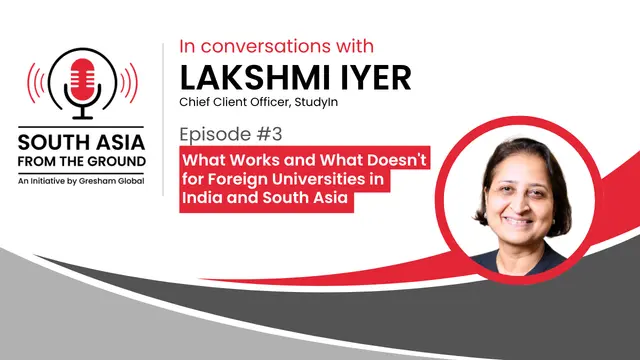
A conversation with Lakshmi Iyer, Chief Client Officer, StudyIn
About South Asia, From the Ground
South Asia, From the Ground is a conversation-led platform built on the insights, experiences, and perspectives of industry leaders across South Asia, bringing on-ground voices to the forefront of global education discussions.
India’s appeal to international universities is easy to recognise. Understanding how to build a meaningful presence in the country is more complex.
In the third episode of South Asia, From the Ground, host Jasminder Khanna speaks with Lakshmi Iyer about what works and what doesn’t for foreign universities engaging with India and South Asia.
Drawing on more than two and a half decades in international education, Lakshmi explores why scale alone is not a strategy, how student expectations are changing, and why lasting success depends on relationships rather than recruitment targets alone.
From Recruitment Market to Strategic Partner
For Lakshmi, one of the most important shifts is how international institutions view India.
The conversation is moving beyond recruiting students towards developing talent, supporting innovation, and building academic partnerships. This calls for a different kind of engagement: one that recognises what Indian institutions, students, and industry bring to the table.
Recruitment remains important, but it cannot be the entire relationship. Universities need to consider how their ambitions connect with the priorities of local partners, and what both sides stand to gain.
As Lakshmi explains, the focus is increasingly “not about just filling seats,” but about attracting the right students and building relationships that offer value beyond enrolment.
The Volume Trap
India’s size can create unrealistic expectations.
Lakshmi cautions against assuming that a large population will automatically translate into rapid recruitment growth. Students and families are increasingly discerning, and an international degree must offer more than the appeal of studying overseas.
Questions about employability, affordability, scholarships, and return on investment now sit at the centre of the conversation. For institutions accustomed to separating education from employment outcomes, this can require a significant change in approach.
| “It’s very easy to fall into the volume trap when it comes to India.”
The implication is clear: universities must explain not only what students will study, but how that education can support their future.
One Country, Many Different Markets
Understanding India requires more than familiarity with a few cities or years of occasional visits.
Lakshmi highlights how attitudes towards education, programme preferences, and the ability to invest can differ across regions. A strategy that resonates in one part of the country may not translate elsewhere.
This is why she advocates humility: the willingness to question assumptions, listen to local perspectives, and recognise that experience in another market does not automatically provide the right answers for India.
| “What suits a state in the south of India might not suit a state in the north.”
Local presence matters because these differences are difficult to understand from a distance. Its value lies not simply in having representatives on the ground, but in allowing their understanding to inform institutional decisions.
Partnerships Need More Than an MOU
Signing an agreement and building a productive partnership are not the same thing.
During the conversation, Jasminder draws attention to the gap between creating partnerships and making them work. Lakshmi reinforces the importance of sustained engagement, face-to-face interaction, and a long-term commitment.
Credibility, she argues, comes from reciprocal value creation. Both institutions need to contribute something meaningful, rather than treating one as a junior partner.
These relationships must also extend beyond individual academics. Institution-to-institution commitment gives collaboration a stronger foundation and a clearer connection to shared goals.
For universities entering India, patience is therefore part of the strategy. Lakshmi suggests that meaningful traction may take around three years, describes five years as a short-term outlook, and places a medium-term view at seven to ten years. These are planning horizons, not promises of results.
Agent Relationships Are a Shared Responsibility
The same principle applies to recruitment partnerships: a signed contract is only the beginning.
Lakshmi describes an agency landscape that has become more complex, with networks, aggregators, and referral partners requiring different forms of engagement. Universities need to invest in training that reaches the people actually advising students, with clear guidance on programmes, suitability, compliance, and quality.
Conversion is also increasingly a shared responsibility.
An agent’s ability to support a student depends partly on the university’s responsiveness: how smoothly it issues offers, answers questions, communicates scholarships, and resolves problems.
| “My ability to convert is also dependent on how good the institution is in terms of their own conversion work.”
Strong relationships therefore need strong processes behind them. Being accessible and dependable can matter as much as being visible.
Looking Beyond Traditional Recruitment
Asked about priorities for the next five years, Lakshmi identifies three opportunities:
Transnational education: collaborative pathways, including arrangements where students complete parts of their education in India and overseas.
Work-integrated learning: connecting academic study more closely with industry experience and career readiness.
Personalised curriculum delivery: exploring learning that responds more closely to individual needs and pace.
Together, these priorities point towards a broader approach to international engagement—one that considers how education is delivered, how students access it, and how it prepares them for work.
Looking Ahead
India offers substantial opportunity, but Lakshmi’s message is that opportunity should not be mistaken for easy access.
Universities need a distinctive offering, realistic investment, and the willingness to build relationships over time. They must also be prepared to answer increasingly searching questions about cost, skills, and the value of a degree.
Perhaps the clearest distinction comes in the rapid-fire round, when Lakshmi is asked which capability every international office should build:
| “India understanding, not knowledge, India understanding.”
That distinction captures the conversation’s central message. Knowing the market’s size is not enough. Meaningful engagement begins with understanding the people, expectations, and partnerships that shape it.
About Lakshmi Iyer
Lakshmi Iyer has worked in international education for more than two and a half decades, beginning her career as a study abroad counsellor before moving into leadership and advisory roles supporting universities’ engagement with India. Her experience spans student recruitment, institutional partnerships, and the evolving expectations of Indian students and families.